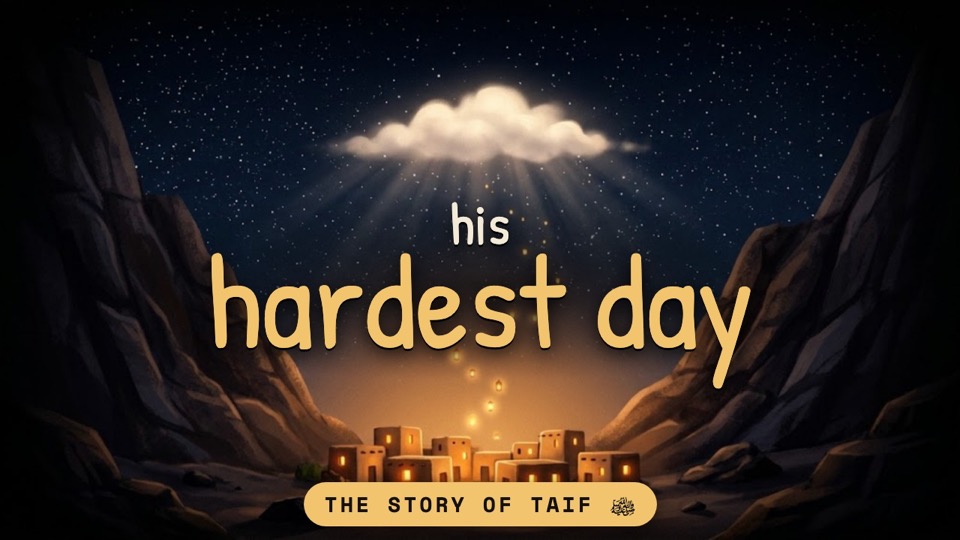
The Hardest Day of the Prophet ﷺ: Ta’if and the Angel of the Mountains

Aisha asked him if any day had been harder than Uhud. He said yes. This is that day, and what he chose when he could have had his revenge.

The Hardest Day of Prophet Muhammad ﷺ: the story of Ta’if

4 min read · Reviewed 19 October 2026 · Told only from authentic hadith, linked to sunnah.com

In short: After his people in Makkah rejected him, the Prophet ﷺ went to ask the leaders of Ta’if for support, and they turned him away. Walking back in deep grief, he was shaded by a cloud. Jibril called to him, and the angel of the mountains offered to crush the people between two mountains. He said no, and hoped their children would one day worship Allah alone.

The question

Aisha (may Allah be pleased with her) asked the Prophet ﷺ whether he had ever faced a day harder than the day of Uhud, the battle where he was wounded and many Companions were killed. He told her his people had hurt him greatly, and that the hardest was the day of al-‘Aqabah (Sahih al-Bukhari 3231).

📩 Free Ramadan 2027 checklist

Join the weekly AskUmmah email: a sourced dua, 5 quiz questions and the Islamic dates coming up. Confirm your email and get the printable checklist free.

No spam. Unsubscribe anytime. Privacy

Rejected

He presented his message to Ibn ‘Abd Yalil ibn ‘Abd Kulal, a leader of Ta’if, who gave him no answer he hoped for. The Prophet ﷺ left, overwhelmed with sorrow, and kept walking without noticing where he was until he reached Qarn ath-Tha‘alib (Bukhari 3231).

The hadith calls it “the day of al-‘Aqabah”. Scholars of hadith explain that this refers to his journey to Ta’if. We have left out details that are not in this hadith.

The cloud and the angel

He raised his head and found a cloud shading him. In it was Jibril, who called out that Allah had heard what his people said to him and how they answered him, and had sent the angel of the mountains to do whatever he commanded.

The angel of the mountains greeted him and said that, if he wished, he would bring the two mountains of Makkah (al-Akhshabayn) down on them (Bukhari 3231, Sahih Muslim 1795).

His answer

He had every reason to say yes. Instead he said no. He hoped that Allah would bring from their descendants people who would worship Allah alone, without partners (Bukhari 3231).

He chose to wait for people who had not been born yet. Allah describes him: “And We have not sent you except as a mercy to the worlds” (Quran 21:107).

What we can take from it

  • Grief is not weakness. The best of creation walked without knowing where he was going from sorrow. Allah still heard.
  • Help can come in the moment you feel most alone. The cloud came after the rejection, not before it.
  • Mercy is a choice made when you have power. He was offered revenge and chose hope for their children instead.

We retell authentic texts with their sources and leave out details that are not in them. We do not issue rulings; for personal questions, please ask a qualified scholar. Spotted a mistake? Let us know.

💬 Get a daily dua on WhatsApp

More stories

Frequently asked questions

What happened at Ta’if?

The Prophet ﷺ asked the leaders of Ta’if to accept his message and they rejected him. On his way back, Jibril came and the angel of the mountains offered to crush the people; the Prophet ﷺ refused and hoped their descendants would worship Allah (Sahih al-Bukhari 3231, Sahih Muslim 1795).

Why was Ta’if the hardest day?

When Aisha asked if any day was harder than Uhud, the Prophet ﷺ said the hardest was the day he presented himself to Ibn ‘Abd Yalil and was rejected (Sahih al-Bukhari 3231).

What did the angel of the mountains offer?

To bring the two mountains of Makkah (al-Akhshabayn) down on them. The Prophet ﷺ said no.

Keep exploring